Bromeliads

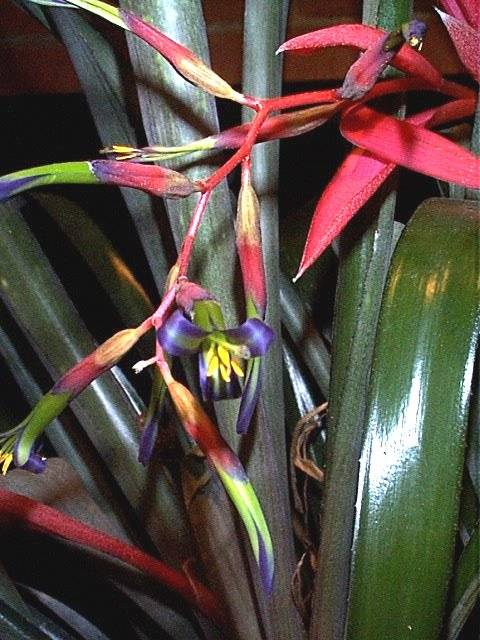
 When I moved into this house almost 11 years ago, the owner left me 2 plants that I'm sure she hated. Plants she thought were ugly. One of those was a bromeliad. You know the kind, has a flower once in its lifetime and that's it. Each year the parent plants have pups and that one plant is now a bunch of plants. If you are familiar with these plants, you know that after the parent plant flowers, it has baby plants grow off of the base of it. When the babies or pups as they are called, have grown large enough, the parent plant will die off, leaving behind several new plants in its place. The new plants will produce flowers when they are mature and produce pups of their own, repeating the cycle. An example of a well-known bromeliad is a pineapple. It's also a big surprise to people to find out that Spanish Moss is a member of the bromeliad family. Spanish Moss is not a moss.
Today, I took a peek on the lanai after work to see what work I needed to do this weekend and guess what I found in the corner? You got it! Several pots of bromeliads were hiding in deep dark corner. One of them is in desperate need of getting a new home. The current quarters are very cramped and the parent plant is still attached to the pups. When the pups are about 1/3 the size of the parent they are safe to be detached from the parent and will survive on their own. The usual soil mix I use is soil and peat moss mix. I keep them moist but not soaking wet.
 |
| Tree covered by Spanish Moss |
 |
| Tillandsia utriculata |
For the past two years, my Bottle Brush tree has been home to a special bromeliad that is an endangered species. A large air plant that is native to southern Florida, Mexico and the Caribbean, the Mexican Boll Weevil and over-harvesting are what have put this plant in jeopardy. It takes approximately 7 years for this plant to flower, but after it does, it will die. So, to be honest, I'm not really looking forward to the showy display because I know that it will be gone. It is the largest of all of the air plants in the United States. I feel like winds of luck blew my way and dropped the plant into my tree. This bromeliad does not have pups. So, I'm hoping that somehow it, reproduces and I get more and this is not the end. Air plants are everywhere in Florida. If you want to try your hand with these, they are very easy to care for. No soil needed and simple misting with a spray bottle or hose (if you keep them outside) is all that's needed. If you keep in a sunny window during the winter months, they should survive just fine even in the cold zones. They will send up stems with a single flower on each stem in the spring. I've had 2 little teeny Tillandsias (air plants) for almost 11 years and they are still alive and kicking.
Good sources of info on Bromeliads:
http://www.bsi.org/brom_info/what.html
http://www.bromeliads.info/
http://www.bromeliad.com/
http://fcbs.org/



 When I moved into this house almost 11 years ago, the owner left me 2 plants that I'm sure she hated. Plants she thought were ugly. One of those was a bromeliad. You know the kind, has a flower once in its lifetime and that's it. Each year the parent plants have pups and that one plant is now a bunch of plants. If you are familiar with these plants, you know that after the parent plant flowers, it has baby plants grow off of the base of it. When the babies or pups as they are called, have grown large enough, the parent plant will die off, leaving behind several new plants in its place. The new plants will produce flowers when they are mature and produce pups of their own, repeating the cycle. An example of a well-known bromeliad is a pineapple. It's also a big surprise to people to find out that Spanish Moss is a member of the bromeliad family. Spanish Moss is not a moss.

